
In partnership with


Hi AInauts,
Welcome to the latest issue of your favorite newsletter.
Another eventful week. Nvidia has affairs involving suspicions of espionage (and perhaps a new CEO soon?), while a major showdown is brewing between Anthropic and OpenAI.
Anthropic released Fable 5.2 just before its IPO, aiming to claim the top spot. OpenAI seems to be waiting for the right moment to crash the party with its latest model...
Of course, we grabbed Fable 5.2 straight away and, as always, checked what it does for regular people like us. Honestly: pretty impressive.
And since everyone is watching the biggest models, we have a tiny one for you at the end. Training it cost just $57, yet it beats the big players at one particular job.
Here's what's inside:
Let's go!
The voice-to-text app that built its own speech model

Most dictation apps are a wrapper around someone else's speech model. Wispr Flow trained its own.
It's called Canto, and it was built for the way people actually talk to AI: thinking out loud, changing direction mid-sentence, half-whispering in an open office.
Wispr tested it on 10 hours of real dictations from more than 2,300 speakers. Canto had the lowest word error rate of every model tested, including models from Google, OpenAI, AssemblyAI and Deepgram. That means your prompts to ChatGPT, Claude and Cursor come through the way you said them.
Talk naturally in any app and Wispr Flow types clean, formatted text, 4x faster than typing.
🧪 Vibe Check: Fable 5.2 tears apart our own projects
Yay, another new model! But this is one of the important ones, which is why we're starting with it.
Two weeks ago, we introduced the Vibe Check, where we test new models on everyday tasks. Now Anthropic has unveiled its "new best" models, Claude Fable 5.2 and Mythos 5.2. A little Vibe Check doesn't quite cover it anymore.
So this time, we ran two tests. Our standard test set comes further down. First, we'll show you what we do with every new smart model. (And what you can try right away, because it's so useful.)

In one sentence: Anthropic's new top model is for the really tough problems. For everyday work, Anthropic itself still recommends Opus 5.5.
But Fable 5.2 really is extremely smart. And right now, Pro subscribers can even try it. More on that below.
What else is new:
Fable for everyone, Mythos for a few: At their core, they're the same model. Fable has safety brakes for cybersecurity and biology. Only vetted organizations get access to Mythos with fewer brakes.
Faster and cheaper: Up to 30% faster than its predecessor. API pricing is $8 per million input tokens and $40 for output, down from $10 and $50.
A step above Opus 5.5: We love Opus 5.5, but Fable 5.2 is starting to pull ahead, especially on challenging tasks.
Our favorite test
Honestly, benchmarks don't tell us much. We want to know whether a new model helps us personally, with our projects and daily work.
So we put every new model into our Second Brain (Claude Code, with access to all our notes, projects, and the real numbers from Google Ads and other tools) and ask exactly one question:
Look at the three projects I've worked on most over the past few days.

Analyze them carefully: Are they set up as well as they could be? Am I doing everything right? Where am I leaving revenue, profit, or value on the table?

Don't rely on my notes. Check the actual numbers. Tell me honestly what you'd do differently, even if it hurts.
We don't tell it which projects, where the data lives, or anything like that. It has to work that out itself. And because they're our projects, we can tell immediately if it's talking nonsense.
You can do this without a Second Brain, too. Just put your project documents into a project in Claude or ChatGPT and let it get to work.
What came out of it
Honestly, it hurt a little.
Project 1: A new AInauten product we're working on
Over the past few days, we've been working on a new product for the AInauten community, planned for 2027.
Strategy, structure, the works: all settled. Fable took it apart. An hour or two later, it was stripped down, tested, and organized in a much better, smarter way.
Visual note: this screenshot is in German. Fable reviews the structure of our planned 2027 product.

Interesting, because AI models aren't usually known for making content leaner and more precise.
Project 2: Lead campaigns that have been profitable for months
The second project Fable looked at was our Google ad campaigns. We've spent months optimizing them and are looking for additional margin.
Alongside further optimizations, Fable pitched Microsoft Ads and immediately analyzed the volume and potential margin.
Visual note: this screenshot is in German. Fable checks Microsoft Ads volume and potential margin.

Normally, we'd have said no to Microsoft Ads because there isn't much search volume there.
Fable convinced us to give it a go, and an hour later it was set up...
Another important lesson for us: In the past, we might not have done things like this because the effort often wasn't worth it. With AI, there's barely any effort. Costs are low, so you can pursue lots of small opportunities, too.
And sometimes, lots of small things add up to something big.
Where it got things wrong
It still confidently says things that aren't true. It told us with complete certainty that ChatGPT doesn't have Skills. Of course it does! It didn't check. It just asserted it.
Still not creative enough, unfortunately. We wanted prompts for creative book covers that also sell, including a title and subtitle. We weren't really happy with the results.
It's seriously good at analyzing and checking the math. Creativity? Not quite there yet.
And our standard test set?
Of course, we ran that too. The same five everyday tasks as always: expenses, a contract, store numbers, trick questions, and a LinkedIn post.
Visual note: the chart labels are in German. Fable: $0.87, 3.2 minutes, all correct. Opus 5.5 (October 28 reference): $0.45, 3.4 minutes, two errors. GPT-6.1 Terra (October 28 reference): $0.05, 1.9 minutes, all correct. LinkedIn scores out of 10: GPT-6 Astra 7.7; Fable and Opus 7.1 each.

Fable gets everything right. It even finds the arithmetic error in the contract in all three runs, the one Opus missed twice in our first test.
But for these tasks, it costs almost twice as much as Opus and is barely faster. On the LinkedIn post, it ties with Opus.
So it's pretty overpowered for everyday work. Anthropic says as much itself.
Use it for large, open-ended tasks where the model needs to pull data, verify it, and do the math. Analyses, audits, "take a look at everything" jobs.
Skip it for quick everyday tasks. Opus 5.5 is enough for those.
The catch: Fable burns through your allowance faster. On Pro, it's only included for the launch period (through November 16, up to half your weekly limit).
Our take: The best model, but only for tough problems 👍
Fable 5.2 feels magical, and we think it's the best model available right now. It's fast and spots things we've overlooked for weeks. But the tasks need to be challenging enough.
Attio is the #1 fastest-growing CRM on Brex and Ramp.

Built for the most ambitious companies in GTM, Attio is an end to end revenue platform that allows teams to run multiple plays across different revenue motions and lifecycles.
Teams at the frontier are already building on it: Granola, turbopuffer, Modal, and many many more.
We have a bit of an agent problem now.
Claude Code for our Second Brain. A Grok Bot team for work. Claude Duet since last week. And ChatGPT joins in sometimes, too.
All really good. But none of them knows what the others know. It's easy to lose track.
We think all of us will work with entire agent teams in the future, if we aren't already. That makes it even more important for everyone to have the same information.
Today, the simplest way to do it:
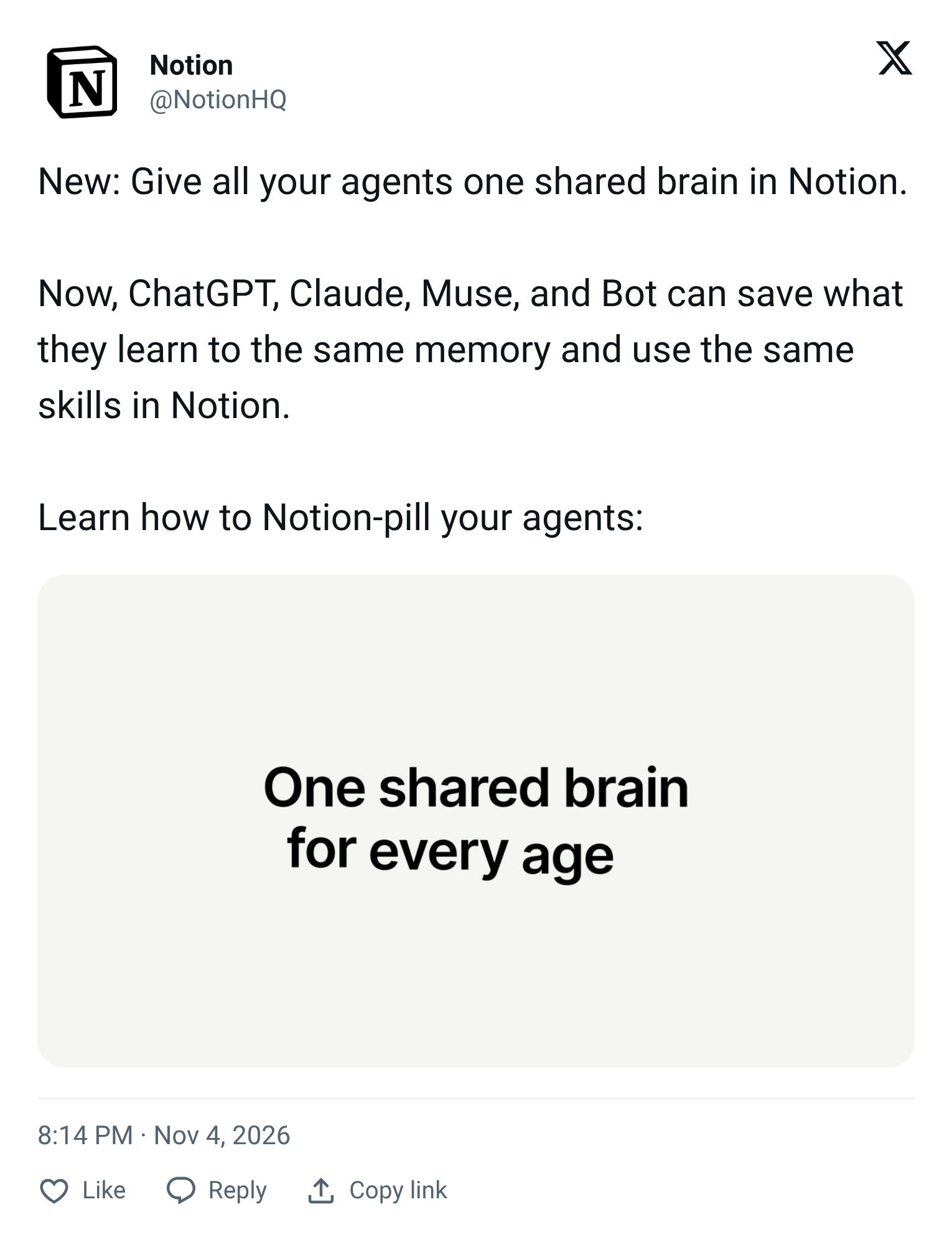
We used Notion heavily for years, but definitely less recently.
Last week, though, they released a really cool feature: a shared memory for all your agents. ChatGPT, Claude, and other agents save what they learn in the same place. And read it from there, too.
The nice part: it takes two minutes to set up!
Grok writes, Claude finds it
We created a separate Notion workspace just for the agents.
Then we connected Claude and Grok Bot to Notion and ran Notion's setup prompt.
It creates a kind of house rules document that every agent reads first.
Then the test: Grok Bot saves a decision in Notion.
A brand-new Claude chat gets just one question: What did we decide today?
Visual note: the German chat shows Claude finding the decision recorded by Grok Bot in Notion.

Claude checked Notion on its own, found Grok's entry, and even noted that Grok Bot had created it.
Two agents, two providers, the same information. Without ever talking to each other.
We prefer that to agents sending each other messages.
Super simple, and always online.
How to get started
Visual note: this screenshot is in German. Select only the dedicated workspace for your agents.

Create a new, empty workspace in Notion. The free plan is enough.
Connect the Notion connector in Claude or ChatGPT. Check the workspace!
Visual note: this screenshot is in German. The Notion connector is available in Claude plugin settings.

Send this prompt:
Set up Notion as a shared memory for my agents. Follow this guide: https://developers.notion.com/prompts/setup

I've connected only the workspace "[NAME]". Work exclusively there. Before importing anything, show me what you want to bring over, and import only what I approve individually.

Keep private and financial information out.
Important: the agent will initially want to know everything about you and suggest copying it over. Approve a small amount first and add more later.
We don't think agents need to talk to each other all the time. Above all, they need the same information.
Notion is currently the easiest way to do that. If you already work with folders and Files over Tools, you don't necessarily need it. But it's fun.
🎯 Small beats big: The $57 model
Earlier, we unleashed the biggest model currently available on our projects and ad campaigns.
Let's finish with the exact opposite.
The small team at loglog.ai rebuilt X as a simulation, complete with users, advertisers, and the ad auction.
Inside it, they trained a small, openly available model (DeepSeek V4.1 Flash) on just one thing: running ads on X.
Training cost a mere $57. Afterward, it even outperformed Gemini, GPT, Grok, and Claude Opus in their simulation! But only in the specific domain of X advertising.

Not the first time
Shopify CEO Tobi Lütke showed something similar in September.
A tiny model that creates shopper profiles at Shopify. At that one specific task, it beats GPT-5.6 Sol, even with Sol running at its highest reasoning setting.
In other words, it beats one of the strongest models around. And it's faster, too: 72 million profiles per day instead of 2 million with the old model.

The pattern is basically the same every time. A big model demonstrates the task, and a small one practices just that one thing until it can do it better and much more cheaply.
Before you cancel your subscription
Only that one task. As soon as something looks different from the training data, a small model like this can quickly get stuck. You'll still need your big model.
The numbers come from loglog itself. And from its own simulation. The team describes its first real tests on X as "sobering."
It only pays off at scale. Shopify does this for millions of calls per day. For 20 emails a week? Probably not.
Our take: Big for everything, small for one thing
The frontier providers will probably end up handling almost everything really well and choosing the right model automatically.
Still, we find the approach of small, trained open-source models very interesting.
Maybe you could simply tell a big model: Find the data and train an open-source model on it. 😉
For most people, this isn't something to copy just yet. But it could become relevant when it comes to costs, autonomy, and more.
That's it for today.
If you try the Vibe Check prompt on your own projects, let us know what came out of it. Even if it hurts. 😉
Thanks for reading!
Reto & Fabian from AInauten
